By which I mean, write down your plot outline before you start writing. “But I’m a panster! I don’t outline!” Tell you a secret? So am I. Doesn’t matter. The reason you should outline is because November is a hectic month for pretty much everyone – I have a theory that’s precisely why we do this challenge in November, to teach us that you can write around all the hiccups and crashes if you really want to. School, work, holidays, stormy weather… sooner or later something is going to disrupt your writing flow, and it’s so much harder to get back into the zone. (For me all it takes is a migraine and I’ve forgotten whatever I was writing.) If you have an outline on hand, you can glance at it, know where you are, should be, and where you need to start working toward, and even if there’s a rocky start to get back into your noveling zen, you’re on the right path.
Okay, you’re thinking, so how do I outline and still pants my novel come November? You need a flexible outline sufficient that you have the big pieces in place, but have left the details out. If you have brainstormed ways to get from point A to point B, great. Doesn’t hurt to write it down. If you haven’t, you’ll be pantsing it the old fashioned way with a scene idea and a blank page.
Plotters, I’m not going to forget you, don’t worry. I just need to make sure the pantsers don’t flee before I get to the important part. I generally assume plotters need no convincing to spend some time plotting.
I do like NaNo Prep 101’s Jot, Bin, Pants limited plotting method, but it leaves a lot more to figure out yourself rather than giving you some structure, so I’m going to focus on the others. If you start reading and absolutely can’t stand the thought of spending this much time on planning ahead, Jot, Bin, Pants is for you.
Resources
In years past, I would have had an even longer blog article about all the ways of creating your outline, from the loose to very detailed. This year, NaNoWriMo has done a bunch of it for me with their NaNo Prep 101 workshop. They’ve even got an interactive quiz for which one is probably for you! (Tip: the more detailed you think you want to get, the further down the list of five they’ve got on that page you want to go.) I’ve copied the worksheets made by the NaNo Prep 101 workshop, just in case their links get taken down later, and you can find links to my copies embedded here. There’s also some other writers with good resources, I know I’ve used Jami Gold’s worksheets for writers before, though I’m less a fan of the way she keeps directing you at her paid workshops. Chuck Wendig has a comprehensive list (semi-NSFW) of ways to plan that’s quite a good read if you don’t mind his language.
Romance writers, your beat sheets are going to differ from the plot arcs of other genres. The plotting method I’m currently working with is from Gwen Hayes’ Romancing the Beat, about which you can learn some here on her site, including a free Scrivener template you can download. I recommend it, and if you sign up for her newsletter, you’ll get a free PDF worksheet version. I can add that Jami Gold offers a romance spreadsheet you can use, but it’s simplistic at best, presumably without the paid workshop to go with it. I really like Gwen Hayes’, and I hope you do too!
Traditional Plot Structure / The Plot Rollercoaster
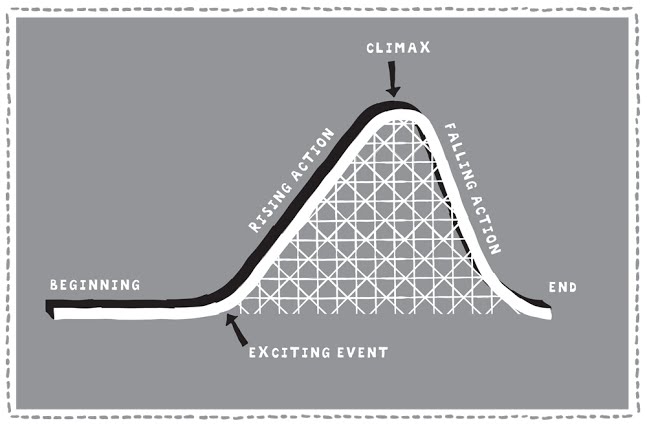
Let’s start out with some basics. The so called “plot rollercoaster” is based on the three acts traditionally taught as the building blocks of a story. When I say ‘traditionally taught’ I don’t mean they’re wrong, mind you, just that there has been a lot more detail added to the explanation by different people over time. Writers have grown out of the basic “beginning, middle, and end” descriptions of the past. Still, your plot overview is going to read something like this:
Act I (0-25%): Set Up. Show us where the story starts. Introduce your story and characters, and then set up the choice to act. Some people throw words like catalyst in here, or inciting incident. Let’s call the early part the hook and the moment of choice the First Plot Point. (Can’t get off the rollercoaster now, Act II is officially kicking off.)
Act II (25%-75%): Rising Action. Something happens to make the hero step out of their daily life and into the plot. They don’t have to choose to be a hero yet, just get moving in the right general direction. The Midpoint (50% mark) is usually a false peak (ie. not the actual climax) or a setback, depending on the story, but now the hero has to be a hero or else. Now they have to struggle to move forward, conflict heats up, and finally there’s a black moment, a point where all hope seems lost. Still, they’ve failed for reasons that teach them something, and now they know what they have to do! Cue the climactic big battle, struggle, or whatever conflict sees the heroes start winning. This turning point is the Second Plot Point. (The heroes are at the top of the world, they have all the information and can see everything they’re about to do spread out ahead of them.)
Act III (75-100%): Falling Action and Finale. Tides have turned, heroes take out each opponent in turn until they’ve won the day. The finale is the victory celebration and the hints at how the characters will go on to live life after the last page of your novel. (Often this means returning all the way to the rollercoaster get on/off point, where the hero returns home or builds a new home, and contrasting it to the opening scene to show the change.)
Seems easy enough, but it can be harder than it sounds. Making such large general categories doesn’t really help if you’re not sure what your heroes should be tackling first. I prefer to make it four groups, where Act II part 1 leads up to the midpoint and then Act II part 2 leads up to the second plot point, just for ease, but whatever works for you. You’ll notice the three acts are not the same length. Acts I and III are about 25% of your estimated total word count, and Act II is the rest. Depending on which advice you take from here, Act I will usually end up shorter than Act III, but Act II is going to stay the majority of your novel. If it weren’t, why would your readers keep reading?
Save the Cat! Beat Sheet
Blake Snyder’s Save the Cat! beat sheet was designed to break the Three Act Structure down into manageable pieces for screenwriters. Some of the terminology is different in his original book, yes, but it applies just as well to novels as it does screenplays. The book has since become the gold standard of plotting, and there are spreadsheets, youtube videos, and all sorts of resources based on the book, both official publications and things other writers have used the template for. I believe there’s even a Save the Cat! novel-specific writing book now, and there’s new Save the Cat! software to plot, storyboard, and write in. (There’s also a subscription discount offer for NaNoWriMo participants.)
NaNo Prep 101 has made us this convenient worksheet to work with, which means you don’t need to investigate any of the links above, it’s all right here. Even if you don’t end up using this method to plot, I strongly recommend you read through the worksheet. The terms Snyder used to describe these scenes and indicators of change have permeated writing culture at this point, and you will come across them again and again. It’s useful to understand where they come from and what they mean.
The 9-Point Plot Dot
You can get the NaNo Prep 101 worksheet for the 9-Point Plot Dot here, and again, it breaks down the structure of your novel into manageable chunks. The difference here is that instead of focusing on the scenes, Derek Murphy highlights the major turning points first. (I know that looks like eight points in a circle, not nine. The “ninth” point is a return to the beginning/normalcy, which is set to contrast with the opening scenes.) These turning points are going to happen in either plotting method, but how you get there is approached differently. You can get his book free on his website, but the explanation is also here on the NaNo Prep blog.
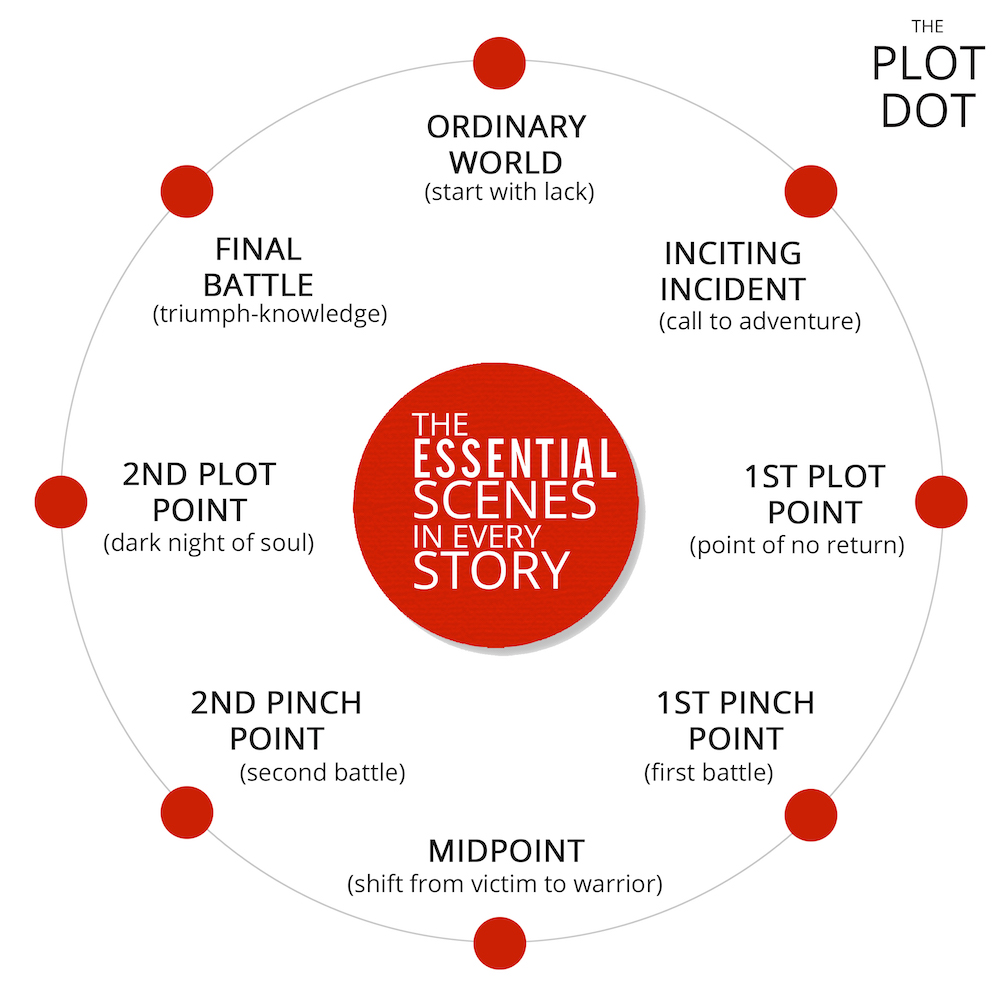
I mentioned earlier that I like breaking the Three Act Structure into four, and this method is essentially why (I just never could’ve put it quite as clearly as Derek Murphy did in his book). The major turning points form the four cardinal points on the diagram above: opening normal scenes where the hero wants something they lack, the first plot point which presents a point of no return, the midpoint change from reacting to taking action, the second plot point’s all is lost moment, and then the final battles that ultimately lead the hero to victory and a new normal once more, just different from where they started. The nine dots are your major scenes, and if you can visualize each of those nine points, you’re probably well on your way to an outline you can work with.
Katytastic’s 27 Chapter Outline
If you’re looking to have every scene laid out clearly, you may be happiest with this. While I will link you to the NaNo Prep 101 worksheet, the real treasure is the youtube video she made explaining it all.
When I was first trying to learn to plot, this was where I started. I wanted to know how to order scenes, what scenes I might be missing, and this is the ideal way to explain it. First she breaks the Three Act Structure into nine blocks, which are the beginning, middle, and end of each Act. Then she repeats that, dividing each block into three chapters. These are straightforward in that everything is based on cause and effect. The introductions may not “cause” the inciting incident, precisely, but once you’ve gotten there, pretty much everything afterward is causality in motion.
Act I (Set Up), Chapter 1: Introductions. Who is your main character? Where is your novel set? What’s the “normal” of the protagonist’s life, and what is it that they want above all else?
Act I, Chapter 2: Inciting Incident (cause the first). Something happens to shake the hero’s world. What is it? How does the hero greet the first glimpse of plot?
Act I, Chapter 3: Fall Out (effect the first). What happens after the inciting incident? Does the antagonist know it happened and make a counter move? Does the hero meet with unpleasantness? Does the new worldview conflict with the hero’s or that of those around him?
Each chapter builds on the one before it, and before you know it, you’ve got a complete outline. When I have used this method to plot out my novels, I don’t always end up with twenty-seven chapters. Sometimes they do better in combination, and I bet the more verbose of us could find reasons to expand the chapter count. My first novel has seventeen (though it needs revisions), and I believe the sequel has eighteen, six chapters in each of three acts. How you divide things up is up to you, whether you leave them as twenty-seven chapters or not, but you’ll need to write at least a scene for each of those twenty-seven items Katytastic laid out.
Your Task, Should You Choose to Accept It…
Read through the worksheets NaNo Prep 101 built. They’re short enough you can skim them to get a sense of each plotting method without having to spend too much time or energy. Skim them and pick one, and write down a few scene notes. These don’t have to be full sentences, even, just a few words that will remind you of the idea you had later. If you can expand them into full descriptions, great. If not, that’s okay, too. You’ll have time to expand on your ideas. The goal is to have something resembling an outline to build upon as you go forward.
October
My next topics will be Characters, Setting, and Plot, and you’ll want both the concept from last week and this week’s outline to work with and on as we go. Your characters will be getting the full development treatment, teasing out the important parts and suggesting the sorts of things to keep track of both before and during November. Settings and Worldbuilding are of importance, in some genres more than others, but we’ll work on making sure you’ve planned settings for all of your important scenes and that you’re making the most of the nuances setting can give to your story. And lastly, I’ll return to plot once again, at which point I expect the concept and outline will have been filled out in such detail that you probably won’t need more thoughts on plot, but I’ll have some last advice for you anyway.
Please let me know if you’ve enjoyed any of these articles or if anything is confusing! You can use the comment feature on each post, the form on my contact page, or @MEfromson on Twitter or Facebook if you’d like a faster response!
 Marie Efromson
3 thoughts on “Pretty Please, Pick a Plot!”